SUPPLY AND DEMAND OF
CURRICULUM-BASED PROFESSIONAL LEARNING
COMMUNICATIONS TOOLKIT
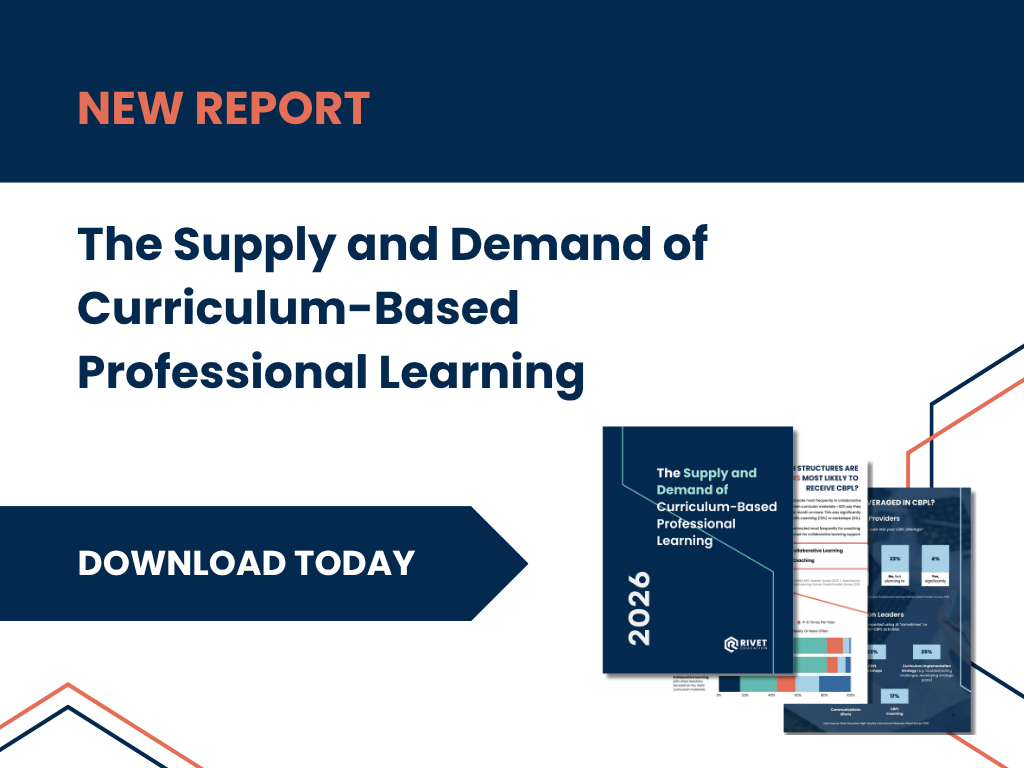
Thank you for helping amplify this year’s The Supply and Demand of Curriculum-Based Professional Learning (CBPL) brief.
This year’s report brings together insights from Rivet Education, the Center for Education Market Dynamics (CEMD), RAND, and Rivet’s own HQIM leadership panel and Professional Learning Partner Guide (PLPG) provider network to offer a detailed picture of curriculum-based professional learning (CBPL) and high-quality instructional materials (HQIM) implementation nationwide.
The 2026 edition explores trends in HQIM adoption, the evolving demand for CBPL, how providers and school systems are adapting support structures, and which professional learning strategies educators report having the greatest impact on instruction and student learning.
For any questions, please reach out to Claire Rivero, Communications Director, Rivet Education (claire.rivero@riveteducation.org)
Toolkit Components
Talking Points
Key messages and ready-to-use language to support your outreach efforts.
Newsletter & Email
Copy and paste content to easily share updates with your audience.
Approved Language
About the Report
The Supply and Demand of Curriculum-Based Professional Learning 2026 synthesizes national data from Rivet Education, the Center for Education Market Dynamics (CEMD), and RAND.
The report is designed to help the field better understand:
- The current state of HQIM adoption nationwide
- What education leaders want from CBPL
- How CBPL is being delivered
- Which CBPL structures educators say have the greatest impact
This year’s report explores more than 30 research questions related to HQIM and CBPL, a record amount of data for this report.
HQIM adoption continues to rise
- HQIM adoption increased significantly across ELA, math, and science. This year, the percentage of districts that have adopted HQIM in at least one grade band rose to:
- ELA 72%
- Math 71%
- Science 21%
- ELA HQIM adoption saw the largest jump nationally (52%-72%), driven partially by the inclusion of state-specific versions of green-rated EdReports curricula (previously not included).
- Historically underserved students generally access HQIM at rates equal to or greater than white peers.
- Science HQIM adoption lags behind math and ELA driven in part by the lack of green-rated curricula on EdReports.
The field’s understanding of CBPL has expanded, and demands have diversified
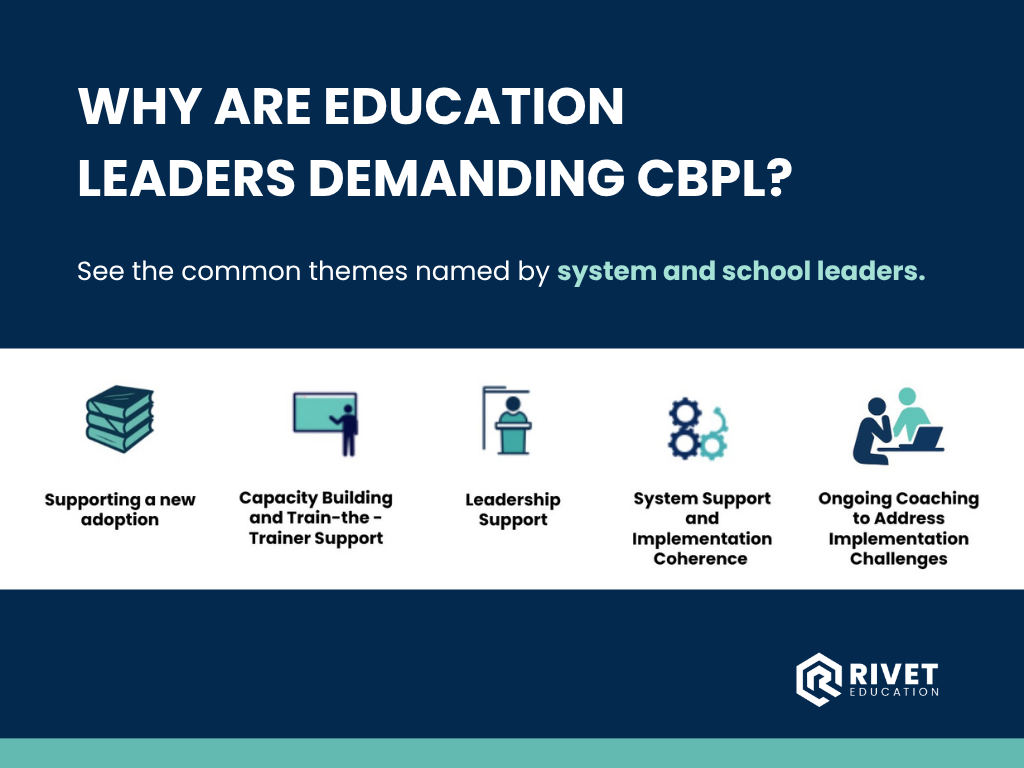
Where once, the field reported demands focused on helping teachers to use a new HQIM, this year’s findings represent a more holistic understanding of HQIM implementation and the CBPL required to make HQIM successful. School systems report requesting:
- Capacity building and train-the-trainer support
- Leadership support for HQIM implementation
- System alignment and implementation coherence guidance
- Ongoing support, including coaching to support evolving implementation needs
Ongoing support is now the dominant demand
- “Ongoing support for teachers” remains the most requested CBPL type for the second year in a row
- Coaching replaced workshops as the most requested professional learning structure from external providers.
- CBPL providers report delivering workshops primarily during the summer, but all other structures are overwhelmingly provided in an ongoing way throughout the year.
Time remains the greatest CBPL implementation barrier
Education leaders identified:
- Lack of time for teachers to participate in CBPL
- Budget constraints
- Lack of internal expertise
as the top barriers to sustaining CBPL.
CBPL providers are evolving their services to meet diversifying demands, by:
- Increasing customization and responsiveness to clients’ needs
- Offering flexible delivery models, such as virtual coaching or tiers of support to match budgets. Both providers and education leaders reported that a hybrid model — combining in-person and virtual support — is now the most common delivery structure for CBPL.
- Increasing the amount of leadership support as well as diversifying how they support leaders. Providers increasingly report offering support around:
- Conducting observations
- Understanding curriculum components
- Implementation data monitoring and data collection
- Support for altering systems and structures (e.g. adjusting schedules) to support HQIM implementation.
AI is playing an increasing role in supporting CBPL implementation
CBPL providers are increasingly embracing AI to support their work:
- 43% said they use it in limited ways
- 4% said they use it significantly
- 23% said they didn’t use AI but were planning on incorporating it
School system leaders report using AI to meet a diverse set of CBPL needs including:
- Instructional support for teachers
- Designing workshops
- Supporting curriculum implementation strategy and troubleshooting challenges
- Aiding communication efforts
- Supporting CBPL coaching
Trends in who is providing CBPL remain consistent across years, but gaps emerge in CBPL supply
Internal staff continue to lead most CBPL
Most CBPL is delivered by:
- School system professional learning staff
- Content specialists
- School-based instructional leaders
Publishers continue to play a major role during initial implementation years. While non-publisher external providers play a larger role in CBPL for education leaders. Top reasons for not hiring an external CBPL provider were:
- Lack of budget
- Preference for in-house professional learning
- Perceived lack of need (i.e., teachers already know how to use the HQIM)
Gaps exist for ongoing observations and coaching:
- Most teachers are observed for HQIM-aligned instruction only a few times a year
- Less than a third of school systems perform monthly observations and coaching for teachers
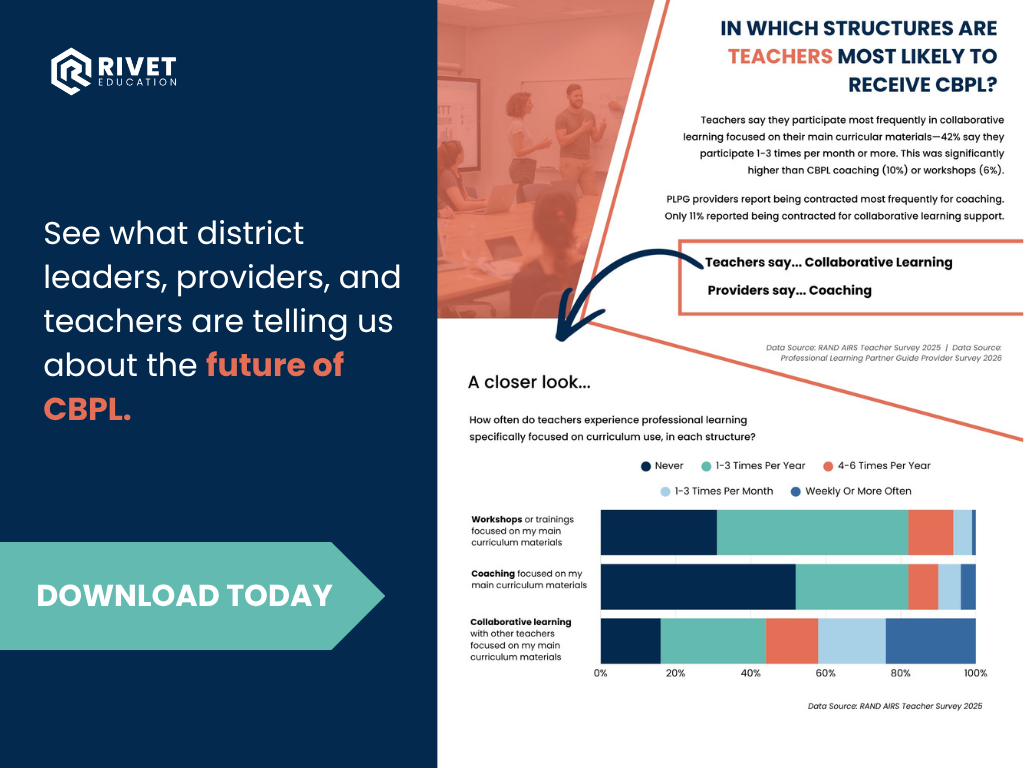
- While CBPL providers report that they are most frequently contracted for coaching, 52% of teachers report they never received coaching focused on their HQIM.
CBPL that supports alignment of tier 2 and tier 3 instruction is limited
Only 36% of CBPL providers say they explicitly support alignment across tiers using the adopted HQIM, while 53% said they sometimes support this depending on the local context.
Trends continue to show the impact of CBPL, especially ongoing structures such as collaborative learning and coaching
School systems are measuring the impact of CBPL through a variety of methods including:
- Classroom observation data
- Teacher feedback surveys
- Student assessment data
- Implementation or fidelity measurement tools
- Teacher attendance and completion of CBPL
10% do not measure the impact of CBPL.
Providers and education leaders agree on the most effective CBPL structures for different CBPL types:
- They agree that workshops are most effective for initial implementation
- They agree that coaching is most effective for ongoing support for teachers and leaders
- Providers find consultations most effective for adoption support, while education leaders report collaborative planning and workshops are most effective for adoption
Ongoing CBPL structures (coaching and collaborative planning) have the most impact
- Education leaders report that CBPL coaching (followed closely by collaborative planning) has the most impact on improving classroom instruction
- According to teachers, the amount of time professional learning focused on curriculum is correlated with agreement that the learning helped them use their materials more effectively and meet student needs.
- Collaborative learning was the most effective structure according to teachers
- Across structures, professional learning that focused on curriculum materials 76%-99% had at least a 90% agreement rate that the learning helped them use their materials and meet student needs.
New Research Report: The Supply and Demand of Curriculum-Based Professional Learning 2026
Rivet Education has released the 2026 edition of The Supply and Demand of Curriculum-Based Professional Learning.
The report synthesizes national data from Rivet Education, the Center for Education Market Dynamics (CEMD), and RAND to help the field better understand:
- The current state of HQIM adoption nationwide
- What education leaders want from CBPL
- How CBPL is being delivered
- Which CBPL structures educators say have the greatest impact
This year’s report explores more than 30 research questions related to HQIM and CBPL, a record amount of data for this report.
This year’s report highlights:
- Rising HQIM adoption nationwide
- Increased demand for coaching and ongoing teacher support
- Increased demand for leadership support
- Persistent barriers like time and budget
- Growing use of hybrid and AI-supported professional learning
- The CBPL structures educators say have the greatest impact
The report offers actionable insights for district leaders, state agencies, professional learning providers, and organizations supporting curriculum implementation.
Subject line: What’s changing in curriculum-based professional learning in 2026?
Hi [NAME],
Rivet Education recently released the 2026 edition of The Supply and Demand of Curriculum-Based Professional Learning, and I thought it might connect to your work.
The report synthesizes national data from Rivet Education, the Center for Education Market Dynamics (CEMD), and RAND to help the field better understand:
- The current state of HQIM adoption nationwide
- What education leaders want from CBPL
- How CBPL is being delivered
- Which CBPL structures educators say have the greatest impact
A few findings that stood out to me:
- Teachers report that coaching focused on their materials is so impactful, but 50% of teachers report never receiving CBPL coaching. How can we fix this, especially with coaches spread so thin?
- So much of CBPL is provided initially by the publisher, but then it shifts sharply back to in-house. How can we help bolster local leaders and prepare them to take on the CBPL lift?
- Many CBPL providers and system leaders are now using AI to support CBPL and HQIM implementation support. What are the risks here? How can we harness AI to expand capacity?
Thought you might find it useful; I’d love to trade thoughts!
Best,
[YOUR NAME]
LinkedIn Post 1
NEW REPORT: What does curriculum-based professional learning look like in 2026?
Rivet Education’s latest national report explores:
- Rising HQIM adoption
- Increasingly diverse CBPL demands including leadership support, HQIM implementation strategy, and ongoing coaching
- Consistent trends in CBPL supply and delivery, and where gaps exist
- Which CBPL structures educators say have the greatest impact
The report synthesizes national data from Rivet Education, the Center for Education Market Dynamics (CEMD), and RAND.
Explore the report and findings that reflect nationwide trends in how teachers and leaders experience CBPL.
https://riveteducation.org/the-supply-and-demand-of-curriculum-based-professional-learning-2026/
LinkedIn Post 2
Teachers who spend the majority of their professional learning time focused on curriculum report stronger instructional impact.
But more than half of teachers still report never receiving curriculum-focused coaching.
The 2026 Supply and Demand of Curriculum-Based Professional Learning report explores:
- Trends in HQIM adoption (on the rise across subjects!)
- What educators say works
- Where CBPL gaps remain
- How districts and external providers are adapting professional learning, including the use of AI
https://riveteducation.org/the-supply-and-demand-of-curriculum-based-professional-learning-2026/
LinkedIn Post 3
HQIM adoption continues to rise nationwide.
But adoption alone isn’t enough.
The 2026 Supply and Demand of Curriculum-Based Professional Learning report highlights a growing need for:
- Ongoing teacher support such as coaching and collaborative learning
- Curriculum-focused coaching and associated observations
- Leadership implementation support
District leaders continue to report that time, staffing, and capacity remain major barriers to sustaining CBPL.
Explore the latest findings from Rivet Education and our national research partners.
https://riveteducation.org/the-supply-and-demand-of-curriculum-based-professional-learning-2026/
LinkedIn Post 4
Hybrid professional learning is no longer emerging — it’s the norm.
Both education leaders and CBPL providers report that hybrid delivery models are now the most common approach to curriculum-based professional learning.
The 2026 CBPL report also explores:
- AI use in professional learning
- Coaching trends
- How CBPL’s impact is being measured
- Tier I, II, and III alignment
- A growing trend in CBPL for leaders
Read the full report: https://riveteducation.org/the-supply-and-demand-of-curriculum-based-professional-learning-2026/
Social Copy (X / Threads)
Option 1
Coaching has officially surpassed workshops as the most requested CBPL structure.
New national data from Rivet Education’s 2026 CBPL report explores:
- HQIM adoption
- Coaching demand
- Leadership support
- High-impact structures
- AI in professional learning
https://riveteducation.org/the-supply-and-demand-of-curriculum-based-professional-learning-2026/
Option 2
Teachers receiving curriculum-focused professional learning report stronger instructional impact.
But many still lack access to curriculum-specific coaching.
New findings in the 2026 CBPL report from Rivet Education, CEMD & RAND.
https://riveteducation.org/the-supply-and-demand-of-curriculum-based-professional-learning-2026/
Option 3
HQIM adoption continues to rise nationwide.
The challenge now: sustaining implementation through ongoing curriculum-based professional learning.
Explore the 2026 CBPL report from Rivet Education.
https://riveteducation.org/the-supply-and-demand-of-curriculum-based-professional-learning-2026/