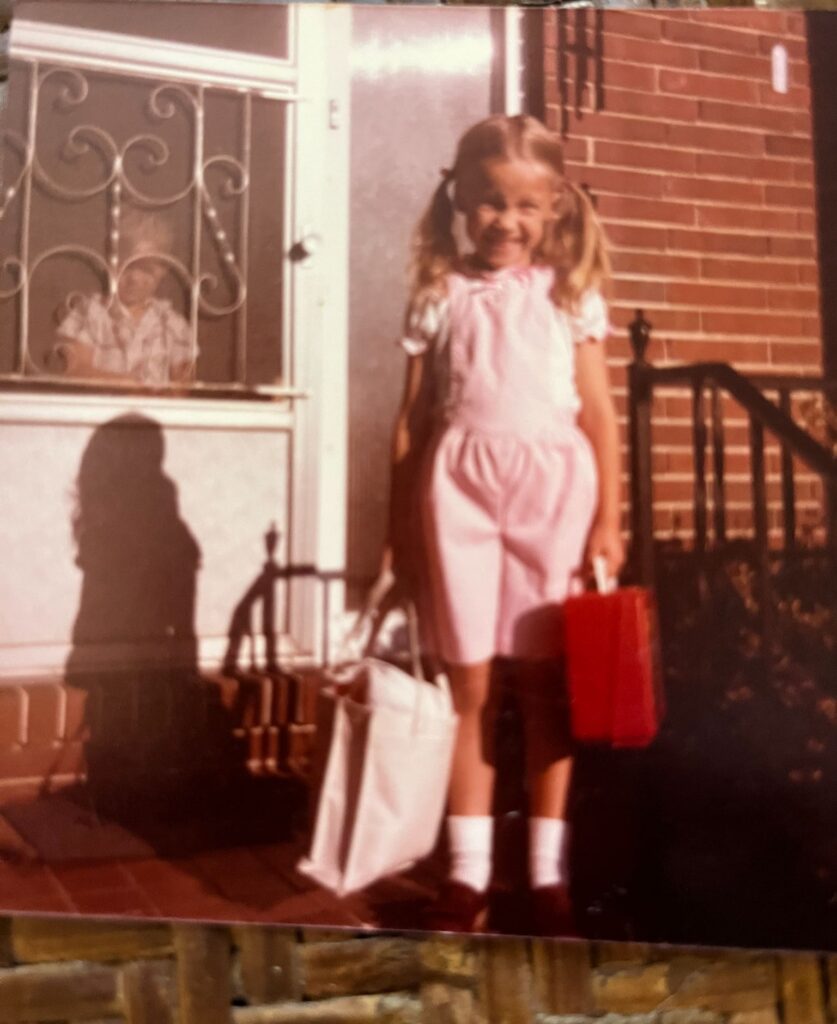
I recently found this picture from my older sister’s first day of school.
She’s standing outside, dressed and ready to go. And if you look closely through the door behind her, you’ll see me. Classic little sister move.
I still love back-to-school. New supplies. New classes. New clothes. Even though I’m no longer starting the year as a student, teacher, or administrator, back-to-school still feels like my New Year’s celebration, but with the added benefit that I don’t have to stay awake until midnight. There’s something irresistible about a fresh start.
And there’s also a trap.
Fresh starts make us want to go big. New year, new curriculum, new PLC structure, new protocols, new expectations. We see everything we eventually want to be true and try to make it true at once. But change is hard. One of the best ways to make change stick is to shrink it, and this is just as true when implementing high-quality instructional materials as it is for any other change.
Regular PLC or collaborative planning time can be one of the most powerful ways to help teachers understand and use their HQIM. But if teachers are learning new materials and a new collaborative planning process, among all the other things that come with a new year, we can easily make the change feel enormous.
So instead of starting with a complete internalization protocol, start with one small move:
Ask teachers to experience the lesson as students.
When I supported Eureka Math implementation at KIPP schools across the country, leaders often asked me how they could help teachers better understand the materials.
My answer was always the same:
Do the math. Talk about the math.
And by “do the math,” I don’t mean make an answer key.
Solve the problems the way you expect students to solve them. Then talk together:
- Where might students get stuck?
- What misconceptions might surface?
- What would successful student thinking look like?
For ELA, the move is just as simple:
Read the text. Talk about the text.
You don’t need to redesign your PLCs before the next meeting. You don’t need the perfect protocol.
At your next PLC, pick one important portion of an upcoming lesson. Ask teachers to be students and then spend time talking about what they noticed.
Do it. Notice it. Talk about it.
That’s enough to start. Once that becomes a habit, add another layer. Then another. Because when we’re excited about a fresh start, our instinct is often to make the change bigger, but sometimes the best thing a leader can do is make it smaller.
One lesson. One PLC. One small move.