If you asked a room full of educators to design their ideal professional learning, ongoing coaching would likely top the list. Yet, recent findings from Rivet’s Supply and Demand of Curriculum-Based Professional Learning show that instructional coaching isn’t happening nearly as often as it should. And when it does, it’s often not aligned to the resources teachers use every day. In fact, some teachers have never received coaching that’s specifically grounded in their core curriculum, which isn’t surprising when considering the fact that 54% of schools with a literacy coach have only one and 36% of schools don’t have a literacy coach at all.
At The Literacy Architects, instructional coaching is a core component of how we partner with schools to help them reach their goals. Over time, we’ve found what research suggests to be true: that the most transformative coaching doesn’t just focus on general pedagogy — it is deeply anchored in the specific materials teachers use every day.
Whether you are a coach on the ground or a system leader trying to strengthen your infrastructure, here are five principles we’ve learned along the way to make our curriculum-based coaching effective.
1. Be realistic about the coach’s caseload (and workload).
Some schools hire one instructional coach, assign them the task of developing all classroom teachers, and then also put them in charge of progress monitoring, state testing, and lunch duty. Just like one reading specialist isn’t the magic bullet for bringing all students to grade level (a conversation for another day…), one instructional coach stretched across 40 teachers is a coach who can only put out fires. At a school we worked with recently, the coach said her job was “90% admin, 10% coaching,” and was working into the night trying her best to support her teachers through email. This is not sustainable!
Effective curriculum-based coaching requires significant prep work: studying the curriculum, observing lessons, and facilitating meaningful co-planning. System leaders must protect coaches’ time and cap their caseloads so they can go deep with a core group of educators rather than merely skimming the surface of an entire building.
When we work with schools on curriculum-based professional learning, we ask leaders what the instructional coach is in charge of, and how we can supplement that work to lighten their caseload – allowing them to truly focus on a specific group of educators. For example, in a recent partnership, the instructional coach asked us to coach the teaching assistants and special education teachers, allowing her to focus fully on the K–3 teachers. This gave her the time to observe more lessons and prepare more effectively – ultimately strengthening the coaching that those teachers received.
2. Ground your observations and conversations in the curriculum.
General coaching often focuses on pedagogical skills like “increasing wait time” or “improving transitions.” While helpful, it lacks immediate context. On the other hand, curriculum-based coaching allows the coach and teacher to tackle the actual lesson. Instead of saying, “Let’s work on student engagement,” curriculum-based feedback would be, “The next lesson will introduce the -ck spelling rule. Let’s look at the sound-spelling routine and figure out how to make this accessible for students A, B, and C who aren’t yet comfortable with identifying short vowel sounds.” This shift makes the feedback instantly actionable and highly relevant.
3. Share the strengths.
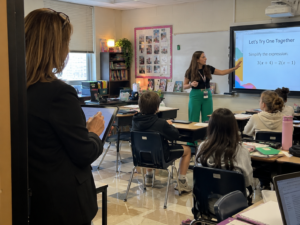
Teachers love learning from other teachers, but their schedules rarely allow them to observe each other’s lessons or share best practices. Instructional coaches have a bird’s eye view, though – you’re in and out of classrooms and know what everyone is doing well. Take a look at those shining spots and think about which teachers could benefit from knowing about them.
For example, during a recent partnership with a charter school network, I noticed the strong management routines that one interventionist was using with her small group. The next day, I observed a new teacher who was having challenges in this area. I offered a few strategies for him to try, but his ears really perked up when I described what the interventionist was doing. The next time I came to see him? That strategy was the one that had stuck.
4. Be intentional with your coaching moves.
Effective coaches don’t wing their feedback conversations; they use a structured approach. The RPPL Coaching Moves Framework is an excellent tool for this, as it synthesizes existing coaching research into a structured taxonomy of coaching moves. By using this framework, coaches can ensure consistency in coaching quality. This is especially useful if you have more than one coach in your building, or if you are using an outside partner to supplement your coaching needs.
The framework encourages coaches to navigate conversations through five specific dimensions:
- Stance: Is the coach sharing information by providing a statement or eliciting it from the teacher in the form of a question?
- Perspective: Is the coach’s question or statement focused on discussing prior events or planning for the future?
- Object: Who or what is the focus of the question or statement?
- Function: What kind of analysis does the question or statement involve?
- Tone: What is the emotional tenor that accompanies the statement or question?
Pages 8 and 9 of the framework connect coaching moves to coaching goals and can serve as a useful planning tool for instructional coaches.
5. Provide opportunities for rehearsal and modeling.
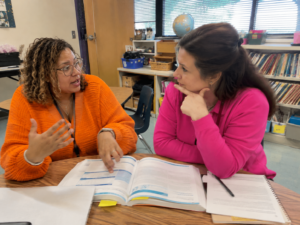
Giving teachers a safe space to practice future lessons can be a great use of time. Teachers often have to internalize lessons quickly and don’t have the support of considering lesson adjustments with a thought partner. In our planning conversations with teachers, we often open up the teacher’s manual and look at what scaffolds or engagement strategies may need to be added to tomorrow’s lesson. Then, we role play or model key parts of the lesson so that the teacher feels comfortable going into the lesson with students. As one teacher recently said, “Continue modeling for our tangible learners – it’s great to see leaders in action.”
If you’re a district or school leader realizing that your coaching isn’t curriculum-grounded, we recommend a coaching audit. Ask your coaches to estimate what percentage of their coaching conversations are directly anchored in the specific texts, modules, or curriculum manuals your school uses. Then, ask your teachers the same question. If the answers indicate curriculum-grounded coaching isn’t the priority, clarify the goal: the primary purpose of coaching in your building is to support the thoughtful execution of the HQIM. Then, clear the operational hurdles (caseloads, scheduling, and training) to make that a reality for your instructional coaches.